Coffee Table for Living Room: Complete Buying Guide for Indian Homes (2026)
Right size, height, shape, material, and styling tips — everything you need before buying a coffee table online in India.
Quick Summary
A coffee table that is too tall, too small, or the wrong shape for your sofa makes the entire living room feel off. This guide covers the four sizing rules every buyer must follow, which shape suits which room and sofa type, why MDF fails daily Indian use, what material handles chai glasses and hot snacks, honest 2026 price ranges, and six styling tips that work in any Indian living room.
A coffee table is the social centre of your living room. Every gathering, every lazy Sunday, every evening cup of chai happens around it. It is also the piece of furniture most people buy purely on looks — and then regret when it is too tall, too small, or constantly in the way. This guide covers the rules that make the difference between a coffee table that works and one that frustrates.
THE MOST IMPORTANT RULE: SIZE RELATIVE TO YOUR SOFA
The single biggest mistake people make when buying a coffee table is getting the proportions wrong relative to their sofa.
Table Length: Should be ½ to ⅔ of sofa length. A 72-inch sofa needs a coffee table 36–48 inches long. Longer looks overwhelming, shorter looks lost.
Table Height: Same as or 1–2 inches below sofa seat height. Standard Indian sofa seat height is 17–18 inches. Coffee table should be 16–19 inches tall. Higher forces you to lean forward awkwardly.
Gap from Sofa: 14–18 inches (35–45 cm). Enough to reach items without leaning uncomfortably, but close enough to use easily. Too far away defeats the purpose.
Walking Clearance: Minimum 30 inches on all open sides. People need to walk around the coffee table without squeezing. Less than 30 inches and guests trip over it at every gathering.
Quick Test Before Ordering: Place a cardboard box the approximate size of the coffee table you are considering in front of your sofa. Sit down. Reach for it. Walk around it. Does it feel right? This 5-minute test costs nothing and tells you everything a product photo cannot.
SHAPE — THE CHOICE THAT DEFINES YOUR ROOM'S PERSONALITY
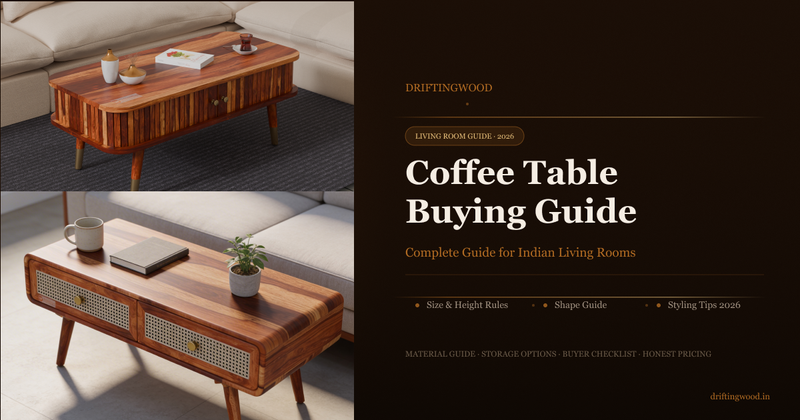
Rectangular: The most practical shape for most Indian living rooms. Maximises usable surface area. Works best with a 3-seater sofa. Easily accommodates a tray, books, and a plant simultaneously. Most versatile.
Round / Oval: No sharp corners — the safest choice for homes with young children. Softer visual feel. Works especially well in smaller rooms or with an L-shape sofa. Less usable surface than rectangular.
Square: Works best with sectional or L-shape sofas where seating is on multiple sides. Equal access from all angles. Less common in Indian living rooms but growing in popularity.
Nesting Tables: Two or three tables that slide under each other. Excellent for small rooms — pull out extra tables when guests arrive, push back when not needed. Very practical for Indian hospitality culture.
Irregular / Organic Shapes: Artisan-crafted statement pieces — slab wood, river edges, asymmetric forms. Not suitable for formal or traditional interiors.
Two Small Tables: Two smaller tables instead of one large one. Flexible — rearrange for guests, move one to the side when not needed. Increasingly popular in modern Indian apartments.
MATERIAL — WHAT WORKS AND WHAT FAILS IN INDIAN LIVING ROOMS
The coffee table takes the most abuse of any living room surface — tea glasses, chai cups, hot snack plates, TV remotes thrown down carelessly, and feet occasionally rested on it.
Solid Sheesham Wood: India's best choice for a coffee table. Handles heat from chai glasses, resists stains with basic care, and develops a beautiful patina over years of use. Can be refinished if heavily marked. Lasts 20+ years. Recommended.
Solid Mango Wood: Good budget alternative to sheesham. Slightly less dense but far superior to any engineered wood option. Good for mid-range budget buyers.
Glass Top with Wood Base: Popular modern look. Glass is easy to wipe clean. However, glass chips and cracks from impact — especially with young children around. Tempered glass is safer but not unbreakable.
Marble Top with Wood Base: Premium aesthetic, excellent heat resistance. Heavy — difficult to move. Marble is porous and stains with acidic liquids like lemon juice. Needs sealing and careful maintenance.
Metal Frame with Wood or Glass: Industrial and modern aesthetic. Metal frames are extremely durable. Look for powder-coated metal — raw metal rusts in humid Indian conditions.
MDF / Engineered Wood: Avoid for coffee tables. MDF swells from the moisture of wet glasses, chips at edges, and cannot be repaired. A surface that takes daily abuse should never be MDF.
The Chai Test: Indian living rooms see multiple rounds of hot chai daily. Always use coasters on any coffee table — even solid sheesham. The heat from a steel chai glass placed directly on wood leaves a permanent white ring mark. No wood finish is immune to prolonged heat contact without a coaster.
STORAGE FEATURES — DO YOU NEED THEM?
Lower shelf (open): Good for books, magazines, and décor baskets. Collects dust faster than closed storage.
Drawers: Good for remotes, chargers, and small items. Check that drawers do not reduce legroom below the table.
Lift-top mechanism: Practical for laptop use from the sofa and hidden storage. The mechanism adds complexity and potential failure risk.
Ottoman / storage top: Good for blankets and extra cushions with dual seating use. Soft top reduces usable surface for glasses and trays.
No storage (clean top): Good for small rooms and minimalist interiors. Requires discipline to keep the living room tidy.
For most Indian families, a coffee table with a lower open shelf is the sweet spot — it provides storage for magazines, remotes, and a decorative basket without adding mechanical complexity or significantly increasing cost.
WHAT TO CHECK BEFORE BUYING ONLINE
1. Measure your sofa length and calculate the correct table length before looking at any product. The table should be ½ to ⅔ of the sofa's length. Write this number down and filter all products by this dimension.
2. Check table height against your sofa seat height. Measure your sofa seat height from the floor. The coffee table should be within 1–2 inches of this height in either direction.
3. Verify the tabletop material — not just the frame. Many listings describe the legs as solid sheesham but the tabletop as MDF or particle board with a veneer. The top surface takes all the abuse — confirm the top is solid wood.
4. Check finish type — lacquer, oil, or wax. A lacquer finish is most stain-resistant and easiest to wipe clean — the best choice for a coffee table with daily use. Oil or wax finish looks more natural but requires more careful maintenance.
5. For glass-top tables — confirm tempered glass and thickness. Glass coffee tables must use tempered (toughened) glass. Minimum 8mm thickness for safety. Ask: "Is the glass tempered and what is the thickness?"
6. Read reviews filtering for "wobble," "smaller than expected," and "colour different." Wobble means weak joints or uneven legs. Smaller than expected means product photos are misleading. Colour different means the finish does not match the listing photos.
HONEST PRICE RANGES FOR COFFEE TABLES IN INDIA 2026
₹2,000 – ₹6,000: MDF or thin engineered wood, basic finish. Chips and swells within a year of daily use. Surface marks from wet glasses are permanent. Avoid.
₹6,000 – ₹14,000: Mango wood or thick plywood, basic finish, limited storage. Acceptable for light use or a secondary seating area. Check material carefully.
₹14,000 – ₹30,000: Solid sheesham or mango wood, quality lacquer finish, lower shelf or drawer storage. Recommended range for a primary living room coffee table.
₹30,000 – ₹80,000: Premium solid sheesham or teak, marble or glass tops, designer bases, custom finishes, artisan craftsmanship. Statement pieces for premium living rooms.
HOW TO STYLE A COFFEE TABLE THAT ALWAYS LOOKS GOOD
The Rule of Three: Style in odd numbers. Three items on a coffee table always looks more intentional than two or four. One tall item (plant or vase), one medium (book stack), one small (decorative object or coaster set).
Use a Tray: A wooden or metallic tray corrals loose items and makes the table look styled rather than cluttered. Everything inside the tray is decoration. Everything outside is clutter. One tray transforms a messy table instantly.
Vary Heights: A flat arrangement of similarly-sized items looks boring. Vary heights — a tall candle, a medium book stack, a low coaster set. The visual movement created by height variation makes the table feel alive.
One Living Element: A small plant, a succulent, or a fresh flower in a vase adds life to the room in a way no decorative object can. It also visually softens the hard edges of the table itself.
Leave 60% Empty: A styled coffee table should have 60% of its surface empty and accessible. Style takes up 40%. The empty space is what makes the styling visible — and what allows people to actually use the table.
Match the Room's Tone: Warm woods, warm-toned décor, warm lighting — or cool metals, white accents, bright lighting. Do not mix warm and cool tones on the same table.
COFFEE TABLE VS CENTRE TABLE
In Indian usage, "coffee table" and "centre table" refer to the same piece of furniture — a low table placed in front of the sofa in the living room. The term "centre table" is more commonly used in traditional Indian households and furniture stores. When searching online, use both terms — you will find different product ranges and price points indexed under each keyword.
HOW TO CARE FOR YOUR WOODEN COFFEE TABLE
Always use coasters: This is not optional. Hot drinks leave ring marks. Cold drinks leave condensation rings. Both are permanent on unprotected wood surfaces.
Wipe spills immediately with a dry cloth: For dried spills, use a barely damp cloth followed immediately by a dry one. Never leave any liquid on the wood surface.
Oil the surface every 6 months with teak oil or furniture polish: This maintains the wood's resistance to moisture and keeps the grain looking rich.
Avoid placing the table in direct sunlight: Sustained UV exposure causes sheesham to fade and dry out. Position the table away from direct rays or use curtains during peak afternoon hours.
THE BOTTOM LINE
A coffee table sets the scale and tone of the entire living room. Get the size wrong and the room feels off-balance. Get the material wrong and daily use destroys it within years. Get it right — proportional to the sofa, solid wood, correct height, practical storage — and it becomes the piece that quietly makes the whole room work.
Measure your sofa. Calculate the right length. Check the height. Choose solid wood. Style it simply. Buy once.
Browse DriftingWood's full coffee table collection at driftingwood.in/category/living-room
Frequently Asked Questions
What size coffee table do I need for my sofa?
The coffee table length should be ½ to ⅔ of your sofa's length. For a standard 72-inch Indian sofa, this means a coffee table 36–48 inches long. The table height should be within 1–2 inches of your sofa seat height — typically 16–19 inches from the floor.
Which shape coffee table is best for an Indian living room?
Rectangular is the most practical for most Indian living rooms with a 3-seater sofa — it maximises usable surface area. Round or oval tables are the safest choice for homes with young children as they have no sharp corners. Nesting tables are ideal for small rooms where you need flexibility.
What material is best for a coffee table in India?
Solid sheesham wood is the best choice for Indian living rooms. It handles the heat from chai glasses (with coasters), resists daily wear, and can be refinished if marked. MDF coffee tables swell from moisture, chip at edges, and cannot be repaired — avoid for daily use.
What is the difference between a coffee table and a centre table in India?
They are the same piece of furniture. "Centre table" is the traditional Indian term used in most furniture stores and older households. "Coffee table" is the modern English usage. Both refer to the low table placed in front of the sofa in the living room. Search both terms online for the widest range of options.
What is a good price for a solid wood coffee table in India?
A solid sheesham coffee table with a lower shelf or drawer costs between ₹14,000 and ₹30,000 in 2026. Tables below ₹6,000 are typically MDF or thin engineered wood that chips and swells with daily use within a year.