TV Unit Buying Guide: How to Choose the Right TV Cabinet for Your Home (2026)
TV sizes, unit widths, floor vs wall-mounted, wood types, storage features, and honest price ranges — everything you need before buying a TV unit online in India.
Quick Summary
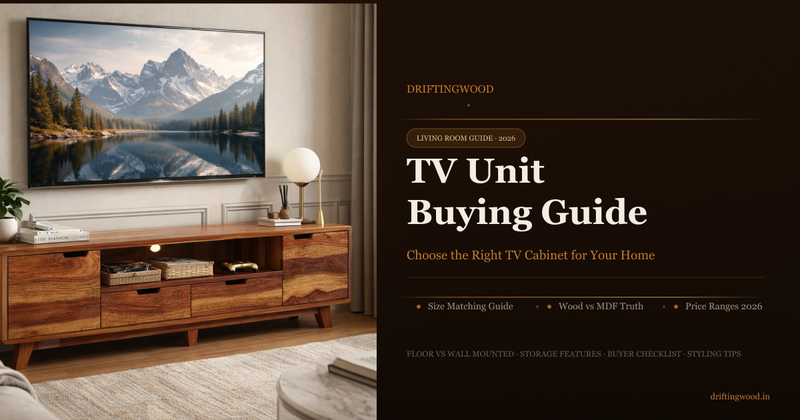
A TV unit is one of the most visible and structurally demanding pieces of furniture in your home. This guide covers how to match unit width to your TV size, floor-standing vs wall-mounted options, why MDF units fail under large TVs, what storage features to look for, and honest 2026 price ranges — so you buy right the first time.
A TV unit is not just a stand for your television. Done right, it organises your living room, hides cable clutter, stores set-top boxes and gaming consoles, and anchors the entire look of your most-used room. Done wrong, it wobbles under the TV's weight, runs out of storage in a month, and looks outdated within a year. This guide helps you get it right the first time.
STEP ONE: MATCH THE TV UNIT WIDTH TO YOUR TV SIZE
The most common mistake when buying a TV unit online is getting the width wrong. The unit should always be wider than the TV — not the same width, not narrower. A TV that overhangs its unit looks unbalanced and creates a tipping risk.
The rule: TV unit width should be at least 1.5 times the TV screen diagonal. Here is what that means in practice:
32-inch TV: Minimum unit width 110–120 cm (43–47 inches). Most compact units work well.
43-inch TV: Minimum unit width 130–150 cm (51–59 inches). Standard units in this range.
55-inch TV: Minimum unit width 150–170 cm (59–67 inches). Medium to large units required.
65-inch TV: Minimum unit width 170–200 cm (67–79 inches). Large units or wall panels recommended.
75-inch and above: 200 cm or more, or a full wall panel unit. Standard units will look undersized.
Height Rule: The centre of your TV screen should be at eye level when seated — approximately 100–110 cm from the floor for most Indian sofas. Factor this into the TV unit height you choose. A unit that is too tall pushes the TV too high, causing neck strain during long viewing sessions.
FLOOR-STANDING VS WALL-MOUNTED TV UNITS
Floor-Standing TV Unit — Pros:
1. No wall drilling — works in any room
2. Built-in storage drawers and shelves
3. Easy to move if you rearrange the room
4. Can house set-top box, router, gaming console
5. Solid wood options available at all price points
Floor-Standing TV Unit — Cons:
1. Takes floor space
2. Cables can still be visible underneath
Wall-Mounted / Floating Unit — Pros:
1. Modern, minimal look
2. Floor stays clear — easier to clean
3. Can be positioned at exact height needed
4. Works well in smaller rooms
Wall-Mounted / Floating Unit — Cons:
1. Requires solid concrete or brick wall — not suitable for hollow partition walls
2. Professional installation needed
3. Cannot be moved without wall damage
4. Less storage than floor-standing units
Indian Context: In most Indian apartments, walls are concrete or brick and can handle wall-mounted units safely. In older buildings or homes with hollow partition walls — stick to floor-standing units. A wall-mounted unit on a hollow partition wall is a safety risk. When in doubt, tap the wall — a hollow sound means use a floor-standing unit.
WHAT WOOD SHOULD YOUR TV UNIT BE?
TV units carry the weight of a television — sometimes 30–50 kg for large screens — plus vibration from speakers. The top panel, shelves, and cabinet structure all need to handle this load daily without sagging or warping.
Sheesham (Solid Wood): Excellent load bearing, high humidity resistance, 20–30 year lifespan. Best choice.
Teak (Solid Wood): Excellent load bearing, very high humidity resistance, 25–40 year lifespan. Premium choice.
Mango Wood (Solid): Good load bearing, moderate humidity resistance, 10–15 year lifespan. Budget solid wood option.
Plywood (18mm+): Good load bearing, moderate humidity resistance, 8–12 year lifespan. Acceptable if thick.
MDF / Particle Board: Poor load bearing, very low humidity resistance, 3–5 year lifespan. Avoid.
MDF and thin engineered wood are the most dangerous choices for TV units specifically. The top panel sags under the weight of large TVs within 2–3 years. Once sagging starts, it cannot be reversed. A ₹8,000 MDF TV unit that requires replacement in 3 years costs more over 10 years than a ₹25,000 solid sheesham unit that lasts 25 years.
STORAGE FEATURES — WHAT TO LOOK FOR
Cable Management Holes: Holes or channels at the back of the unit for routing power cables and HDMI cords. Eliminates visible cable clutter completely. Non-negotiable for a clean setup.
Open Shelves: For set-top boxes, routers, and speakers that need ventilation. Closed cabinets trap heat from electronics — open shelves prevent overheating.
Closed Cabinets with Doors: For hiding clutter — DVDs, remotes, wires, and items you want out of sight. Shutter doors keep dust out better than open shelves.
Drawers: Best for small items — remotes, chargers, batteries, instruction manuals. Look for smooth drawer slides. Cheap slides stick and squeak within months.
Side Shelves / Wing Units: Extended side panels with shelves for books, plants, and décor. Creates a full wall unit look without the cost of a custom built-in.
Back Panel Design: Some units have open backs — useful for wall-mounting and cable routing. Units with solid backs provide better structural rigidity for heavy TVs.
WHAT TO CHECK BEFORE BUYING ONLINE
1. Measure your wall width before buying. The TV unit plus side clearance must fit your wall without blocking doors, windows, or walk paths. A unit that looks small in product photos can dominate a 10-foot wall entirely.
2. Check the top panel thickness and load rating. For a 55-inch or larger TV, the top panel must be at minimum 18mm solid wood or 25mm plywood. Thinner tops sag. Ask the seller for the exact top panel thickness and material if not listed.
3. Verify cable management provisions. Check product images carefully for cable holes at the back. If no cable holes are visible, ask before ordering — retrofitting holes into solid wood is difficult and damages the finish.
4. Check shutter type — push-to-open or handle. Push-to-open shutters look cleaner but can fail over time. Handle shutters are more reliable but add a visual element. Decide based on your preference before ordering — it cannot be changed after delivery.
5. Confirm the back panel material. A solid or thick back panel adds structural stability. Thin cardboard-like back panels are common in cheap units and flex under load — causing the entire unit to lean to one side over time.
6. Check finish on all visible surfaces including the back edge. Some units have beautiful fronts but unfinished rough edges at the back and sides. If the unit sits against a wall this does not matter — but for island placement, all edges must be finished.
7. Read reviews specifically for "sagging," "wobble," and "different from photos." Sagging means the top panel or shelves are too thin. Wobble means poor assembly or weak joints. Different from photos means colour or finish is misleading.
8. Confirm assembly difficulty before ordering. Large TV units can take 3–5 hours to assemble. For units over 150 cm wide, professional assembly is strongly recommended.
HONEST PRICE RANGES FOR TV UNITS IN INDIA 2026
₹4,000 – ₹10,000: MDF or particle board, thin panels, basic finish. Will sag under any TV over 40 inches within 2 years. Avoid.
₹10,000 – ₹20,000: Engineered wood or thick plywood, basic shutters, limited storage. Acceptable for small TVs (32–43 inch) from a reputable brand only.
₹20,000 – ₹40,000: Solid sheesham or mango wood, multiple storage options, cable management, good finish. Recommended range for most buyers with 43–55 inch TVs.
₹40,000 – ₹90,000: Premium solid sheesham or teak, full wall panel units, designer shutters, integrated lighting provisions, custom configurations.
Price Red Flag: A "Solid Sheesham TV Unit" listed under ₹8,000 is not solid sheesham. It is either MDF with a wood-grain print, veneer over particle board, or a misrepresented listing. Genuine solid sheesham has a natural grain that varies across the surface — wood-grain printed MDF looks perfectly uniform. Zoom into product photos and look for grain variation.
TV UNIT VS ENTERTAINMENT UNIT VS WALL PANEL
Compact TV Stand (90–120 cm): Minimal storage. Best for small rooms and 32–43 inch TVs. Price range ₹6,000–₹18,000.
Standard TV Unit (120–160 cm): Good storage. Best for most living rooms with 43–55 inch TVs. Price range ₹15,000–₹40,000.
Entertainment Unit (160–200 cm): Excellent storage. Best for large rooms with 55–65 inch TVs. Price range ₹30,000–₹70,000.
Wall Panel Unit (200–300 cm): Maximum storage. Best for feature walls with 65 inch and above TVs. Price range ₹50,000–₹1,50,000.
Floating / Wall-Mounted (100–180 cm): Moderate storage, modern look. Works for all TV sizes. Price range ₹12,000–₹45,000.
HOW TO STYLE YOUR TV UNIT
Keep the top surface minimal: One decorative item on each side of the TV base — a small plant, a photo frame, a vase. More than that looks cluttered. The TV is the visual focus, not the décor.
Use shelves intentionally: Open shelves visible below the TV should have a consistent visual theme — all books, or all decorative items, or all electronics neatly arranged. Mixing everything looks chaotic.
Manage cables before decorating: Route all cables through the back panel holes before placing the TV and décor. Cables added after the fact are impossible to hide cleanly.
Add a small indoor plant: A pothos or money plant on one side of the TV unit softens the electronic-heavy look and adds warmth naturally.
THE BOTTOM LINE
A TV unit is one of the most visible pieces of furniture in your home — and one of the most structurally demanding. Spending ₹8,000 on an MDF unit that sags in 2 years and buying again costs more than buying a solid sheesham unit for ₹25,000 once.
Measure your wall. Match the width to your TV. Choose solid wood. Check the top panel thickness. Buy once.
Browse DriftingWood's full TV unit collection at driftingwood.in/category/living-room
Frequently Asked Questions
What width TV unit do I need for a 55-inch TV?
For a 55-inch TV, you need a TV unit that is at least 150–170 cm (59–67 inches) wide. The unit should always be wider than the TV — a TV that overhangs its unit looks unbalanced and creates a tipping risk.
Which is better — floor-standing or wall-mounted TV unit?
Floor-standing units offer more storage and work in any room without wall drilling. Wall-mounted units look more modern and keep the floor clear but require solid concrete or brick walls and professional installation. For most Indian homes, a floor-standing solid wood unit is the more practical choice.
What wood is best for a TV unit in India?
Solid sheesham wood is the best choice. It handles the weight of large TVs without sagging, resists India's humidity, and lasts 20–30 years. MDF and particle board TV units sag under TVs over 40 inches within 2–3 years and cannot be repaired.
What is a good price for a solid wood TV unit in India?
A solid sheesham TV unit with good storage costs between ₹20,000 and ₹40,000 in 2026. Units below ₹8,000 claiming solid sheesham are typically MDF with a wood-grain print or veneer over particle board.
How do I hide cables in a TV unit?
Look for a TV unit with cable management holes at the back panel — these allow you to route power cables and HDMI cords through the back and out of sight. Route all cables before placing the TV and décor items for the cleanest result.