Wardrobe for Bedroom: Complete Buying Guide for Indian Homes (2026)
Door types, internal configurations, correct sizes, wood vs engineered, and honest price ranges — everything you need before buying a wardrobe online in India.
Quick Summary
A wardrobe chosen poorly runs out of space in months, warps with humidity, and becomes a daily frustration. This guide covers how much storage you actually need, which door type suits your room, why MDF wardrobes fail in Indian monsoons, what the internal configuration should include for an Indian family, and honest 2026 price ranges so you know exactly what you are getting for your money.
A wardrobe is the most storage-critical piece of furniture in your bedroom. It organises every item of clothing, linen, and bedding your family owns — and when chosen well, it does so invisibly, keeping the bedroom calm and uncluttered. When chosen poorly, it runs out of space in months, warps with humidity, and becomes the source of daily frustration. This guide covers everything you need to choose correctly.
STEP ONE: HOW MUCH STORAGE DO YOU ACTUALLY NEED?
Most people underestimate how much wardrobe space they need. An Indian household typically stores far more than just clothes — it stores bedding, seasonal items, festival attire, extra pillows, and sometimes documents and valuables. A wardrobe that fits perfectly in year one overflows by year two.
The rule: always buy one size larger than you think you need. Wardrobe space fills 20% faster than you expect.
2-Door (~90–100 cm wide): Suits a single person. Not adequate for a couple's full wardrobe in the long term.
3-Door (~130–150 cm wide): The sweet spot for most Indian couples. Adequate storage with a mirror door option.
4-Door (~170–190 cm wide): Ideal for families with children or heavy festival wardrobe. Needs a wide bedroom wall.
6-Door (~220–260 cm wide): Full wall wardrobe. Maximum storage for joint families or large collections.
Indian Wardrobe Reality: The average Indian couple's wardrobe includes sarees, salwar suits, sherwanis, festival clothes, winter bedding, extra pillows, and spare linen — in addition to daily clothing. Factor all of this in when choosing size. A 3-door wardrobe that feels spacious when bought often feels tight within 18 months of a marriage or a new child.
DOOR TYPES — THE CHOICE THAT CHANGES EVERYTHING
Swing / Hinged Doors: Traditional Indian choice. Full access to the entire section when opened. Requires 2–3 feet of clearance in front for the doors to swing. Most reliable mechanism — hinges last decades with minimal maintenance. Most recommended.
Sliding Doors: Modern look, space-saving — no clearance needed in front. However, only one section is accessible at a time. Tracks collect dust and need regular cleaning. Good quality sliding hardware is essential — cheap tracks jam within months.
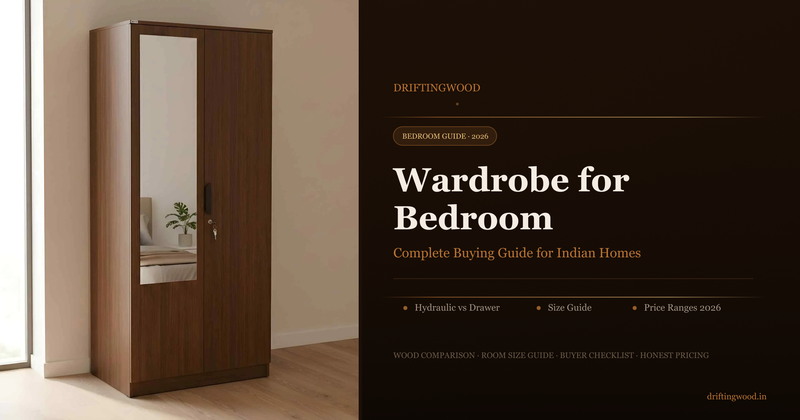
Mirror Doors: Full-length mirror built into one or more doors. Eliminates the need for a separate dressing mirror. Adds visual space to small bedrooms. Heavy — requires strong hinges. Available in both swing and sliding styles.
Louvred / Shutter Doors: Slatted doors that allow air circulation inside. Good for preventing musty smell in humid climates. Practical in coastal regions with high humidity.
Folding / Bifold Doors: Fold in half when opened — less clearance than full swing, more access than sliding. The folding mechanism can misalign over time, especially with heavy solid wood doors.
Open / Doorless: Trending in modern interiors. No door mechanism to fail. Requires very organised storage and regular dusting. Clothes are exposed to dust — not ideal for Indian bedrooms.
For Most Indian Bedrooms: Swing doors with a mirror panel on one door is the most practical combination. Full access, no track to jam, full-length mirror built in, and hinges that last decades. If space is genuinely limited — below 10 feet between the wardrobe and the opposite wall — sliding doors are the right choice.
INTERNAL CONFIGURATION — WHERE MOST BUYERS GO WRONG
Long Hanging Section: Full-height rod for sarees, sherwanis, long dresses, and suits. Minimum 50 inches of vertical clearance needed. Every wardrobe must have at least one long hang section.
Short Hanging Section: Half-height rod for shirts and kurtas — doubles the hanging capacity in the same vertical space. Most efficient use of wardrobe height.
Shelves (Fixed or Adjustable): For folded clothes, bedding, and stacked items. Adjustable shelves are significantly more useful than fixed — they adapt as your storage needs change over the years.
Drawers: For undergarments, accessories, and small items. Full-extension drawer slides are essential — partial extension drawers waste 30% of the drawer depth.
Locker / Safe Section: Small lockable compartment for valuables, documents, and jewellery. Standard in traditional Indian almirahs. Ask specifically if you need one — it is often missing in modern wardrobe designs.
Shoe Rack Section: Angled shelves at the bottom for shoes. Practical but reduces lower hanging space. Only include if you have a separate shoe storage problem to solve.
The ideal internal layout for an Indian couple's wardrobe: one long hang section, one double short-hang section, three to four adjustable shelves, two full-extension drawers, and one lockable locker.
WOOD VS ENGINEERED WOOD — THE DECISION THAT DETERMINES LIFESPAN
Solid Sheesham Wood: Excellent humidity resistance, excellent weight bearing, excellent door hinge strength. 25–40 year lifespan. Best choice.
Solid Teak Wood: Excellent across all categories. 30–50 year lifespan. Premium choice.
Marine Plywood (BWP): High humidity resistance, good weight bearing. 15–20 year lifespan. Good if 18mm or thicker.
Commercial Plywood: Moderate performance. 8–12 year lifespan. Acceptable budget option.
MDF / Particle Board: Very poor humidity resistance, poor weight bearing, poor hinge strength. 3–6 year lifespan. Avoid.
MDF wardrobes swell along the bottom panel from floor moisture during monsoons, the hinge holes strip out from daily use, and shelves sag under the weight of bedding within 2–3 years. Once MDF swells, it cannot be repaired.
The Monsoon Test: During monsoon season, humidity in many Indian cities exceeds 80–90%. MDF absorbs moisture through any exposed edge — the bottom panel, cut edges, and hinge areas. The swelling is permanent and progressive. A wardrobe that looks fine in May will have swollen bottom panels and sticky doors by September. Solid wood and BWP plywood handle these humidity cycles without permanent damage.
GETTING THE DIMENSIONS RIGHT
Height: Standard range 6 ft to 8 ft (180–240 cm). Measure ceiling height — wardrobe must clear the ceiling with door clearance. 7 ft is the Indian standard.
Width: Standard range 3 ft to 8 ft (90–240 cm). Measure the wall and subtract door frame width. Account for skirting board thickness.
Depth: Standard range 18 to 24 inches (45–60 cm). Minimum 20 inches for clothes to hang without touching the back panel. 24 inches is ideal.
Door Swing Clearance: For swing doors — you need at least the door width as clear space in front. Measure before buying.
Hanging Rod Height: Minimum 50–52 inches from floor. Long hang section must have at least 50 inches from rod to floor for sarees and long clothing.
WHAT TO CHECK BEFORE BUYING ONLINE
1. Confirm the panel thickness — specifically shelves and side panels. Minimum 18mm thickness for all structural panels. Thinner panels sag under the weight of folded clothes and bedding within 2 years.
2. Ask specifically about the bottom panel material. The bottom panel is most vulnerable to floor moisture. In MDF wardrobes, the bottom panel swells and warps during monsoons. Ask: "What material and thickness is the bottom panel?"
3. Check the hinge brand for swing door wardrobes. Quality hinges (Hettich, Hafele, or equivalent) last 15–20 years. Unbranded hinges strip out and misalign within 2–3 years. Ask the seller which hinge brand is used.
4. Check sliding track brand for sliding door wardrobes. Cheap sliding tracks jam and warp within months. Quality tracks glide smoothly for years. This is the most common failure point in sliding door wardrobes.
5. Verify the internal layout matches your actual storage needs. Check the product images for an open-door view showing internal shelves, hanging rods, drawers, and locker. If the listing does not show internal images, ask the seller before ordering.
6. Measure the wall and check if assembly can happen in your room. Large wardrobes are assembled in the room — they cannot be brought in fully assembled. The room door must be wide enough for the largest panel to pass through.
7. Check if professional assembly is included. Wardrobe assembly is complex — panels must be perfectly level or doors will not hang correctly. For wardrobes over 3 doors, professional assembly is strongly recommended.
8. Read reviews filtering for "doors not aligning," "shelves sagging," and "swelling." Misaligned doors mean poor assembly or warped panels. Sagging shelves mean thin panels. Swelling means MDF or poor moisture protection.
HONEST PRICE RANGES FOR WARDROBES IN INDIA 2026
₹8,000 – ₹18,000: MDF or thin particle board, basic hinges, fixed shelves. Doors misalign within 1 year. Shelves sag within 2 years. Bottom panel swells in monsoon. Avoid.
₹18,000 – ₹35,000: Commercial plywood or HDF, decent hinges, basic internal layout. Acceptable for a 2–3 door wardrobe from a reputable seller. Confirm panel thickness.
₹35,000 – ₹70,000: Solid sheesham or BWP plywood, quality hinges or tracks, good internal configuration with drawers. Recommended range for a family wardrobe used daily.
₹70,000 – ₹1,80,000: Premium solid sheesham or teak, full-extension drawers, mirror panels, customisable internal layout, designer handles, professional installation included.
Almirah vs Wardrobe: In Indian usage, "almirah" and "wardrobe" are often used interchangeably. Technically, an almirah is a freestanding metal or solid wood cabinet with a traditional Indian design — often with a locker and mirror. When buying online, search both terms — you will find different product ranges and price points under each.
HOW TO CARE FOR YOUR WARDROBE
Keep the bottom elevated from the floor: Place the wardrobe on small rubber pads or wooden feet if it does not already have them. This prevents direct contact with floor moisture — the primary cause of bottom panel damage during monsoons.
Leave the doors slightly open during monsoon months: Keeping a wardrobe completely sealed during high-humidity months traps moisture inside and promotes musty smell. Leave one door slightly ajar during June–September to allow air circulation.
Use silica gel packets inside the wardrobe: Place 2–3 silica gel packets on the internal shelves. Replace every 3 months. They absorb excess humidity and prevent musty odour and mould on clothes.
Oil solid wood surfaces annually: Apply teak oil or linseed oil to all exposed solid wood surfaces once a year. This maintains the wood's natural moisture resistance and prevents cracking in summer months.
Tighten hinge screws every 6 months: Daily opening and closing loosens hinge screws over time. Loose hinges cause doors to sag and misalign. A 2-minute tightening every 6 months prevents the misalignment that most people assume is a permanent problem.
THE BOTTOM LINE
A wardrobe is a 20-year purchase if bought correctly — or a 3-year frustration if bought purely on price. The difference between a solid sheesham wardrobe and an MDF one becomes most visible exactly when you need it most: during the monsoon, when MDF swells and doors stick, and after 5 years of daily use, when MDF shelves sag and hinge holes strip out.
Measure your wall. Choose one size larger than you think you need. Confirm the panel thickness. Check the hinge brand. Ask for the internal layout before ordering. Buy once.
Browse DriftingWood's full wardrobe collection at driftingwood.in/category/bedroom
Frequently Asked Questions
Which wardrobe door type is best for Indian bedrooms?
Swing or hinged doors are the most reliable for Indian bedrooms. They give full access to each section when opened and have no tracks to jam or collect dust. If the room has limited space in front of the wardrobe (less than 10 feet), sliding doors are the practical alternative.
Why do wardrobe doors misalign and stick in India?
The most common causes are MDF panels swelling from monsoon humidity, low-quality hinges that loosen with daily use, and improper installation where panels are not perfectly level. Solid wood wardrobes with quality hinges (Hettich or Hafele) and professional installation avoid all three problems.
What size wardrobe do I need for a couple in India?
A 3-door wardrobe (130–150 cm wide) is the minimum for an Indian couple. Factor in sarees, festival clothes, bedding, and seasonal items — not just daily clothing. If you have the wall space, a 4-door wardrobe will serve you better long-term.
What is the difference between MDF and solid wood wardrobes?
MDF (Medium Density Fibreboard) is manufactured compressed wood fibres. It swells when exposed to humidity, the hinge holes strip out with daily use, and shelves sag under weight — typically failing within 3–6 years in Indian conditions. Solid sheesham wood handles humidity cycles, holds hinges for decades, and lasts 25–40 years.
What is a good price for a solid wood wardrobe in India?
A solid sheesham 3-door wardrobe with quality hinges, drawers, and professional assembly costs between ₹35,000 and ₹70,000 in 2026. Wardrobes below ₹18,000 are almost certainly MDF or thin plywood — the material quality will not be obvious until after the first monsoon season.